


Also published in INSEAD In The Know blog
How times have changed! Just a month ago, the biggest challenge for me was exams. I was in the INSEAD campus for most of the weekend, wearing slippers and frantically studying in a discussion room on-campus.
Look at us now! INSEAD Fontainebleau campus has been closed since 16 March 2020, and we have started our classes using Zoom.
It is non-debatable that this is a crisis that no one had expected before.
Thus, we need to understand that everyone is trying their best with whatever resource they have.
Why is communication important in this situation? Because without proper communication, students are left guessing on what the exact impacts are on them.
It’s counterproductive if students made up their mind on the “perfect” solution before any communications are started. When this happens, the person becomes resistant to anything the school proposes that doesn’t perfectly align with their “perfect” solution. Furthermore, each student has different levels of understanding of what the school can and cannot do, and what kind of other considerations are being made by the school.
Lastly, INSEAD’s relationship with the students is complicated. It’s not exactly a business & clients because the relationship is long term, and even when students graduate, most students still keep in touch with the school. Compare this with your regular hairdresser. When you change hairdresser to a new one, it’s unlikely that you’ll stay in touch with your old one! It’s also not exactly business & employees because the students do pay INSEAD instead of the other way around. Finally, it’s also not like a community organiser and community members, because students don’t just go in and out of the community anytime they want, plus the investment students make in INSEAD is quite significant.
All in all, the situation above makes the relationship management more complicated, and if something works in such a complicated environment, then it could potentially work in many other organisations. I’d like to define that the goal of communications in times of crisis is to minimise disruption to the organisation’s capability to service clients and minimise dissent between organisation & stakeholders.
From what I observed in this period between INSEAD & the students, mass communications need to fulfil the following criteria:
- Quick – In response to changing situations. E.g., new government announcements
- Clear – Leave as little room for doubt as possible, and ideally give proper timelines. E.g., instead of saying “We will potentially do X or Y, and we’ll inform further on a later date”, try to say “We will potentially do X or Y, and we target to inform you by 1 April 2020”.
- Frequent – Don’t let people think that the organisation is not doing anything. E.g., sending updates whenever a new important decision/discussion has been made, and sending a weekly summary update on what discussions or decisions have been made in the past week.
- Empathise – It’s us together against the crisis. Don’t communicate as if you’re the only one inconvenienced by the situation; everyone is impacted.

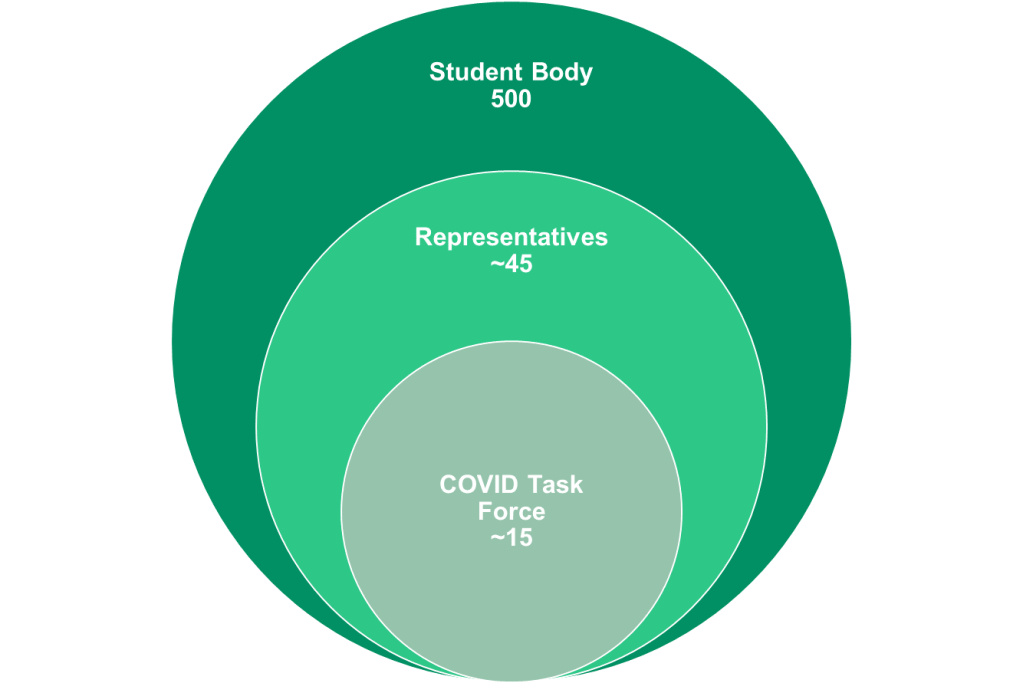
Missing any of the components above will be counterproductive and might cause people to make their conclusions. In addition, a clear communication channel is required. For our current case, the school has a task force made up by selected employees and the student body has a task force made up by elected representatives.
Having a smaller team helps collate information and makes the situation less confusing for everyone.
First, the student representatives receive and understand feedback from the students. Then the student representatives collate the feedback. Following that, the task force communicates with INSEAD’s task force. Finally, INSEAD’s task force, which includes the school’s dean, announce decisions made and actions to be taken as soon as possible.
Together with what to do, there are also a few things not to do, and this doesn’t apply only to the organisation, but also to all stakeholders:
- Take a long time to build a task force for all sides. For example, taking too long to create a student task force and properly defining communication methods.
- Make unnecessary jokes in an attempt to ease people’s mood with humour. Unnecessary jokes and commenting can derail the conversation and build resentment, especially from people who are not in a good state mentally.
- Inspire panic. This is the responsibility of every stakeholder. Emotions are contagious. (Psychology Today on the good, bad and ugly of emotional contagion). In a crisis, I think the effect is amplified due to the pressure and uncertainty of the situation. You can also read up here on how to protect yourself.
- Not fully reading information that is provided by other stakeholders. This point is self-explanatory, but there’s no justification for saying that you don’t know something that has been communicated in email by other stakeholders. It’s no one’s responsibility to make sure you read emails, especially when they’re tagged with an important/urgent title.
To end this short article, in accordance with the times of crisis, I’d like to quote what my professor tells the class at the end of sessions nowadays.
“Wash your hands, eat your vegetables, stay safe!”
 Chris' Learning Notes
3 responses to “Communications in Times of Crisis”
You have an active blog! I’m going to read everything, starting from the oldest (and hopefully, most embarrassing) post. 😀
LikeLiked by 1 person
You have an active blog! I’m going to read everything, starting from the oldest (and hopefully, most embarrassing) post. 😀
LikeLiked by 1 person
Haha thank you Ashish! 👍🏻👍🏻
LikeLike